The quick version
- Two hulls give a steadier, roomier ride than a monohull, so you can walk around, sit on the nets or head below without feeling every swell.
- In Madeira's waters, researchers have verified 27 cetacean species, and deep water just offshore brings larger whales close to the coast.[1][2]
- The Funchal Bay luxury catamaran tour lasts 3 hours, with a live guide in Portuguese and English and a route that takes in Cabo Girão.[3]
- For US$46, the cruise lets you reserve now and pay later, and cancellation is free until 24 hours ahead.[3]
- Sea temperatures off Funchal range from 18°C in winter to 24°C in summer, so pack layers, sun protection and a swimsuit.[4]
- Top choice Luxury catamaran from US$46 Duration3 hours[3]Rating4.25 / 3,470 reviews[3]GuidePortuguese, English[3] Check availability
- All-inclusive luxury from US$91 Duration3 hours[5]Rating4.92 / 2,885 reviews[5]GuideEnglish, Portuguese, Spanish[5] See this tour
- Ecological catamaran from US$40 Duration2.5 - 3 hours[6]Rating4.55 / 10,022 reviews[6]GuideEnglish, Portuguese[6] See this tour
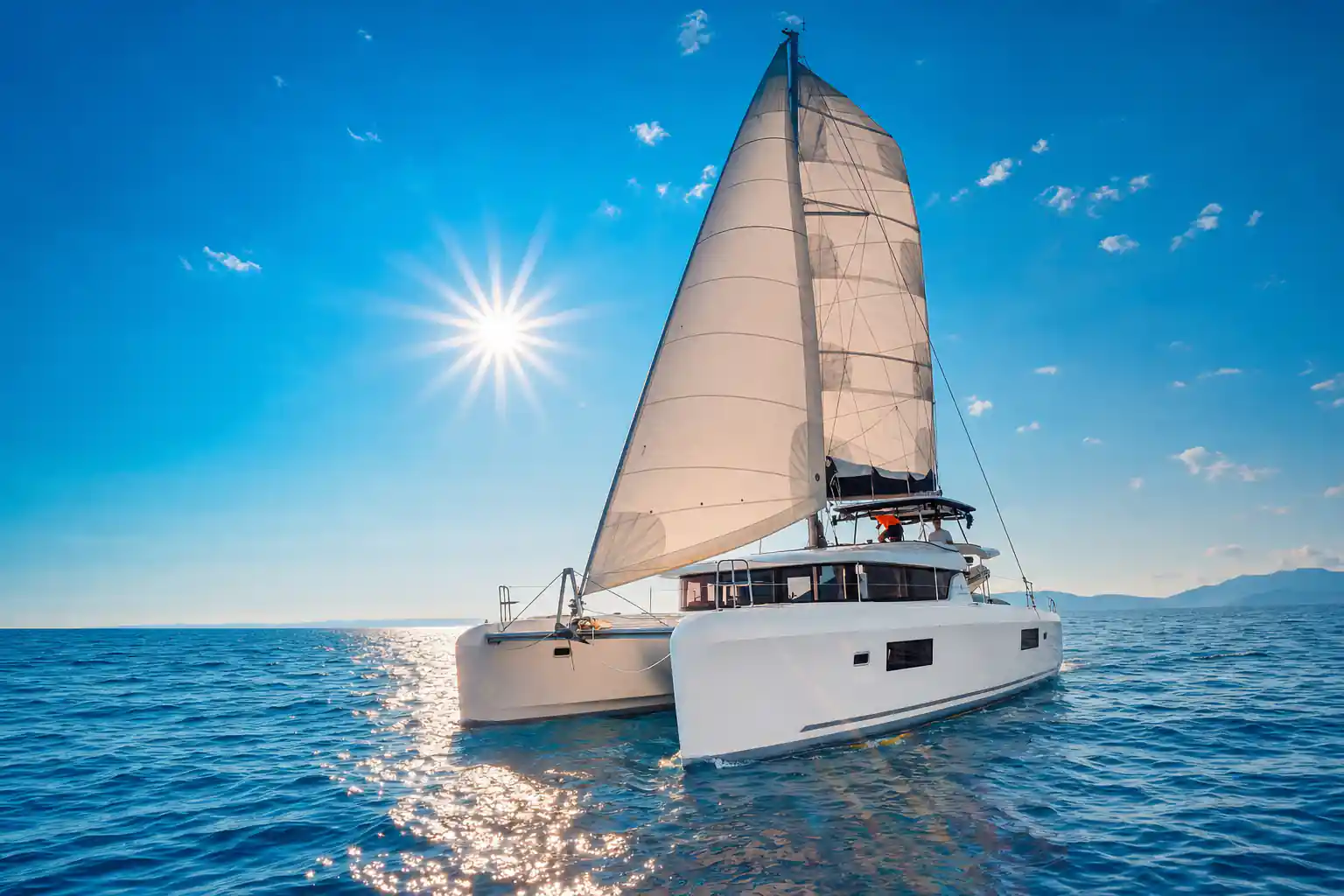
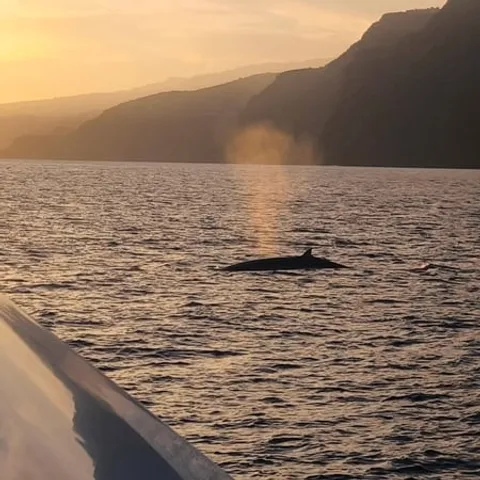
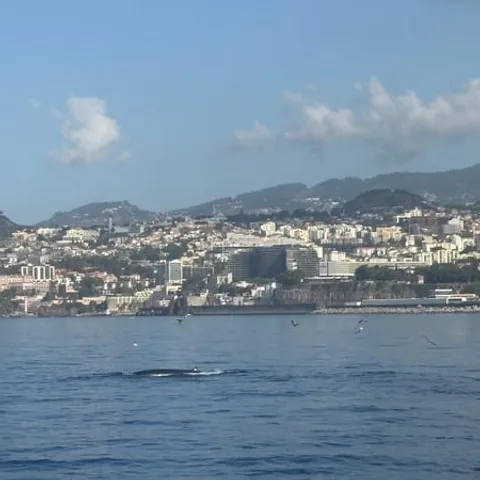
When sea life arrives, our electric engines engage for silent emission-free cruising which helps keep the cetaceans very happy!
A steady, sociable way to go whale watching
Before you sail
What the second hull is actually for
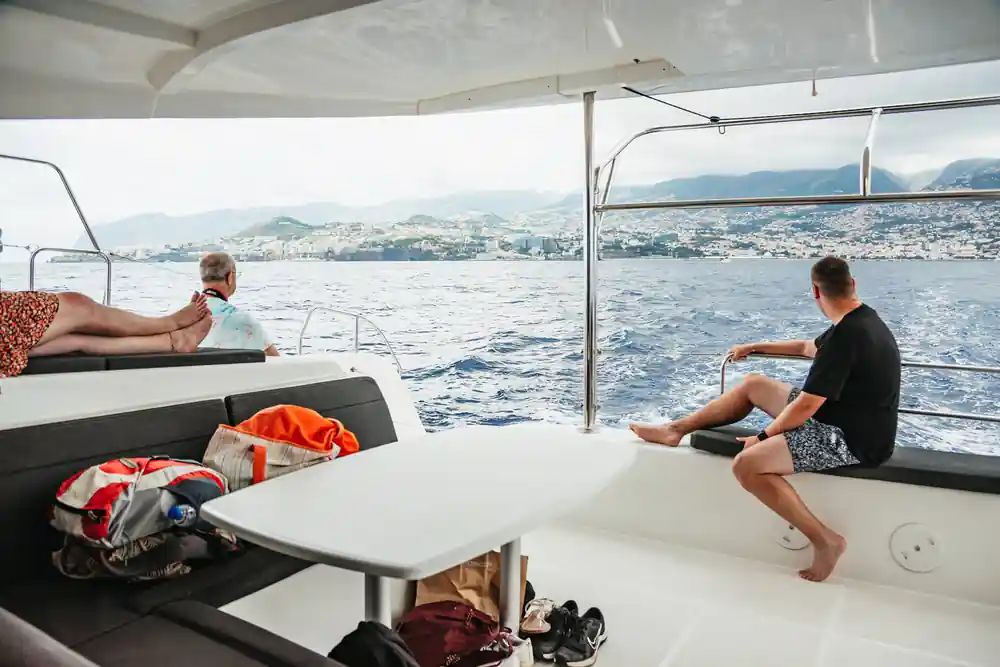
Step onto a catamaran and the first thing you notice is the space. Two hulls carry a wide, flat deck, so the boat does not heel over when the wind picks up the way a single-hulled yacht does. You can stand at the rail, walk from one side to the other, or pour a coffee without hanging on. The cockpit feels like a small terrace, and the bow opens into that stretch of netting between the hulls. For anyone who has felt queasy on a small boat, that steady motion and the open deck are a big comfort; you spend the cruise looking out, not holding on.
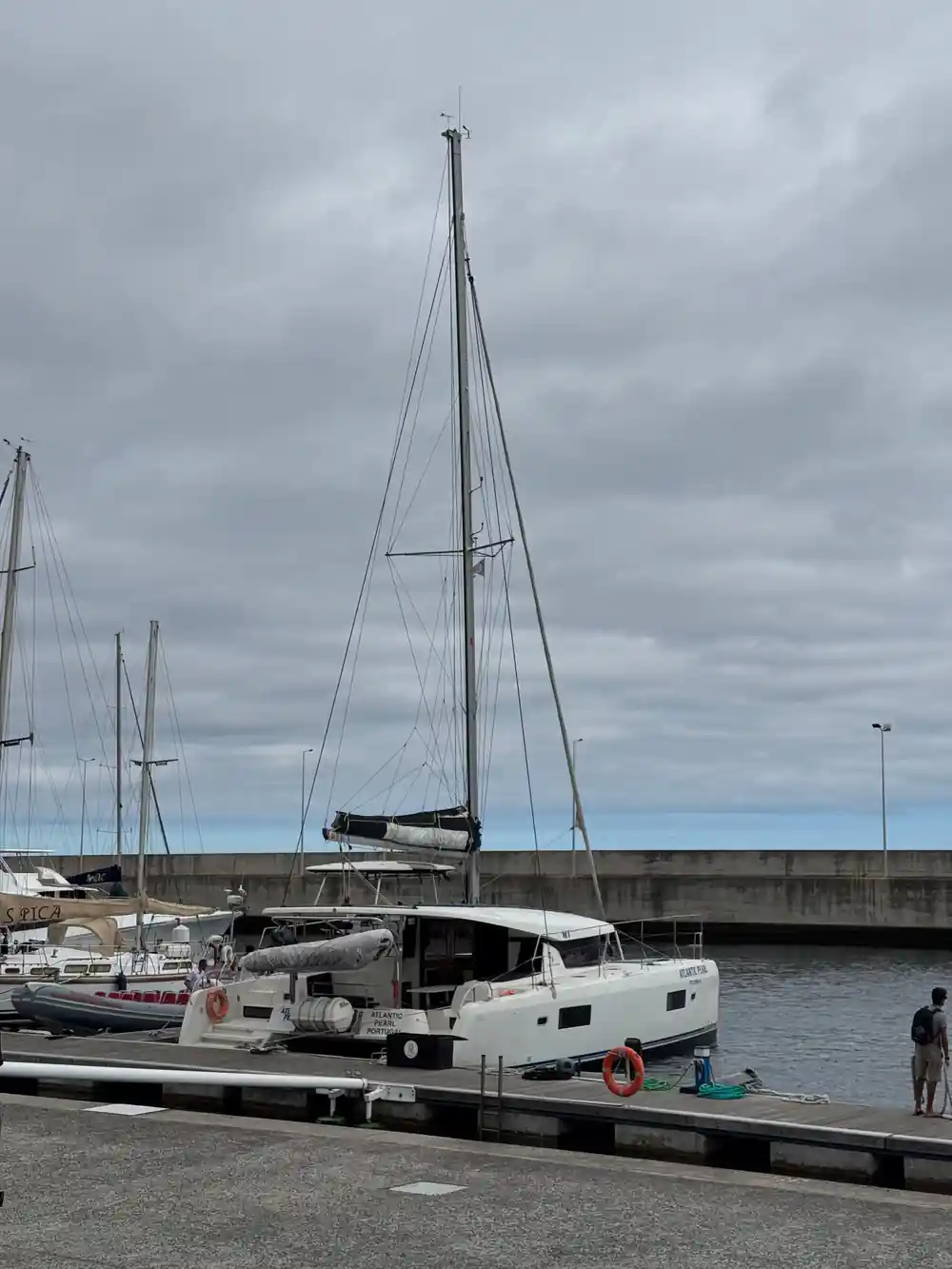
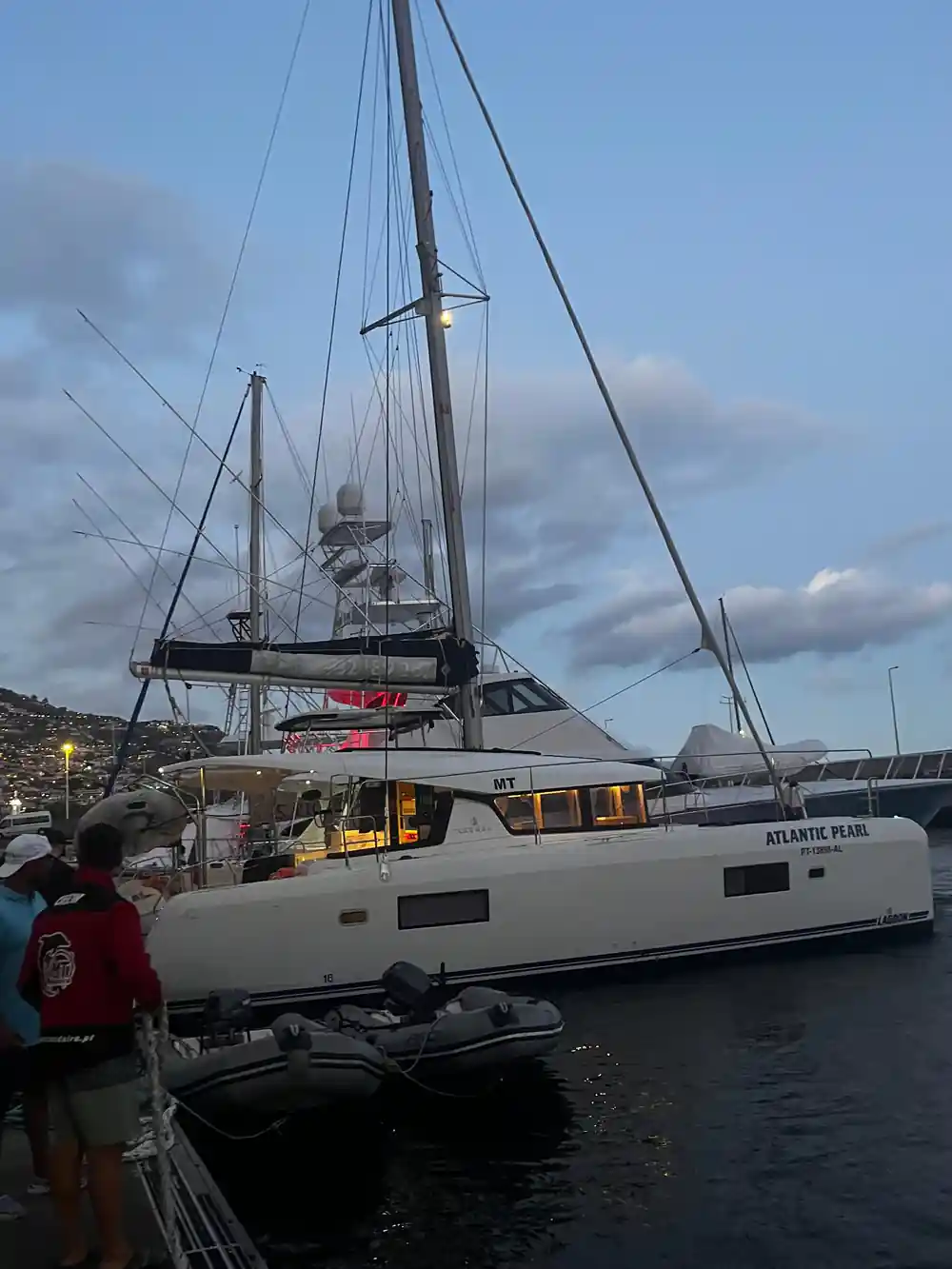
The stability comes from the design. With the weight spread across two hulls, a catamaran floats with barely any tilt, and the wide beam creates a big deck and a calm interior. The Atlantic Pearl, one of the catamarans working in Funchal, is a Lagoon 42 model, a shape known for elegance and character.[7] That is the kind of boat you want when the aim is watching wildlife rather than gripping a rail. The ride is noticeably gentle, with the water sliding past two slim hulls, so lunch stays where you left it and your camera stays in your hand.
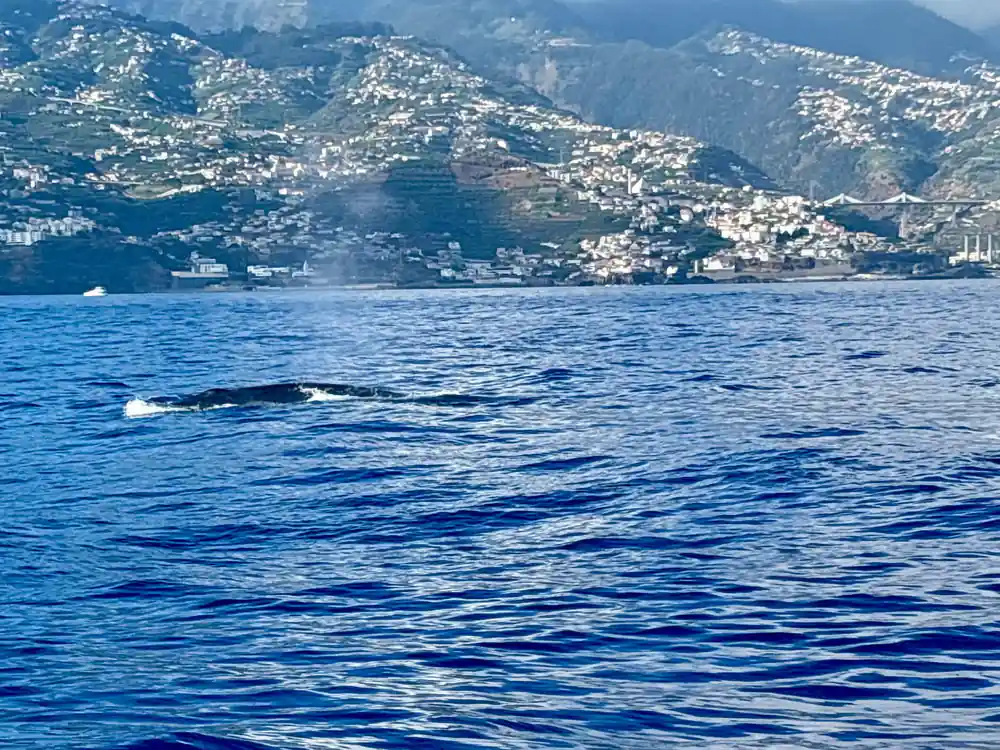
It also matters offshore. Barely five kilometres from Madeira, the ocean floor exceeds 3,000 metres, and its steep slopes and submarine canyons draw deep-water whales near the island.[2] A stable platform lets you follow them with binoculars or line up a photo without the horizon swinging about. When someone calls out from the other side, you can walk across the deck quickly instead of waiting for the boat to turn, which makes a real difference with fast-moving dolphins.
The trampoline nets
Between the two hulls at the front, catamarans have trampoline nets strung tight like a giant hammock. This is a favourite seat on the boat. You lie back on the webbing with the water rushing below, and when dolphins ride the bow wave they are right under you, silver flashes through the mesh. The nets are broad enough for several people to stretch out, and there is nothing between you and the sea but rope webbing.
The nets are firmer than they look, and the crew will tell you where you can sit. Shoes stay on deck, sunglasses need a keeper, and hats should be tucked away. It is wonderfully open, but you are closer to the sea than you might expect, so hold on to anything loose. If the boat is moving fast, spray can come up through the mesh; that is part of the fun, and it is why a quick-dry layer works better than heavy cotton on a day like this.
Photographers love the low angle from the nets, and children love the sense of floating. The Funchal Bay cruise gives you plenty of time on deck; its 3 hours include stops along the way.[3] If dolphins appear at the bow, the nets put you right at the surface, eye to eye with them. The crew usually moves people forward in small groups, so everyone gets a turn without the boat tipping or the deck getting crowded.
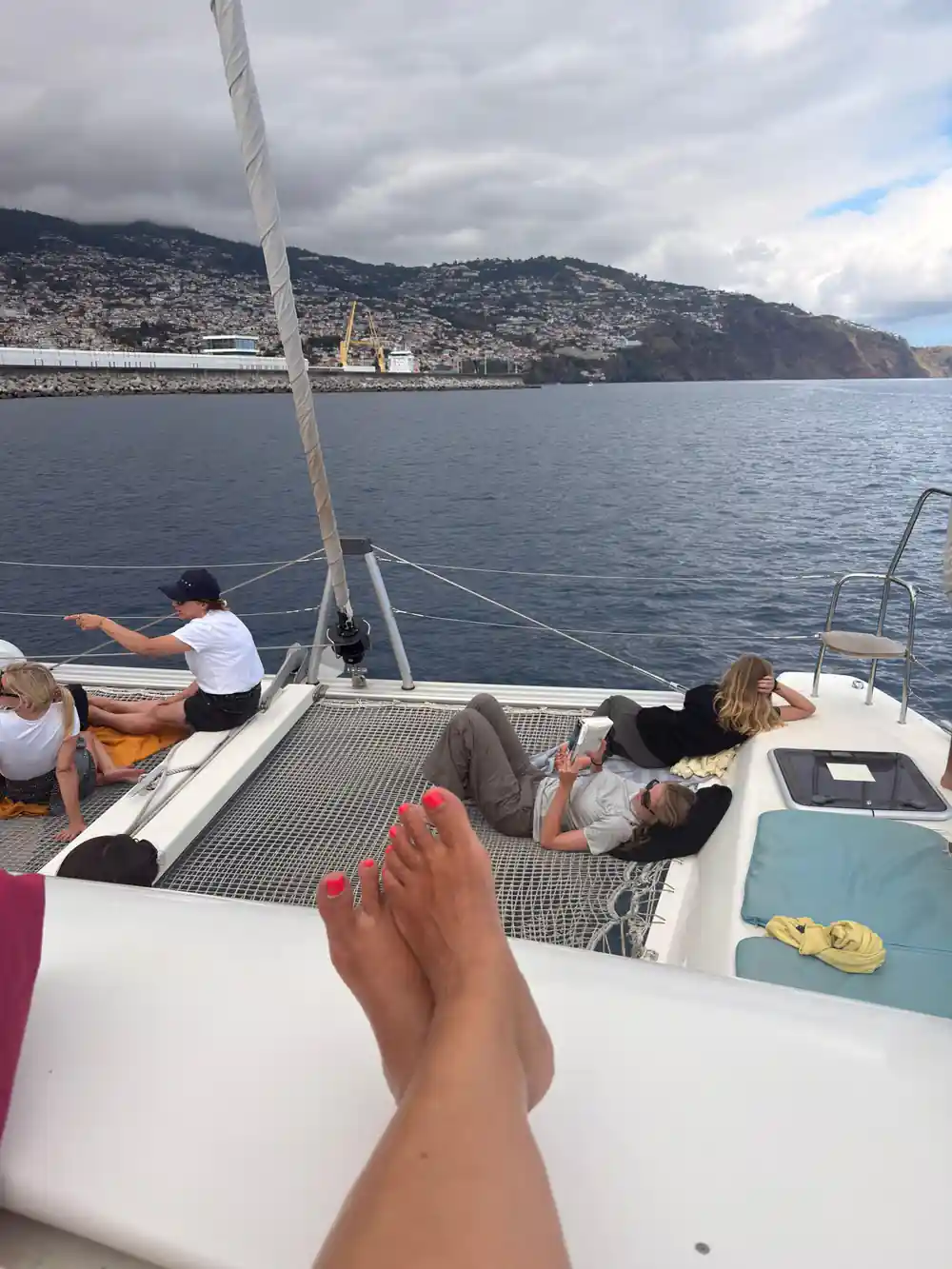
On the nets at the bow, the water slips by just below you.
Shade, which matters more than you think
Madeira's sun is strong even when the breeze is cool. Most luxury catamarans cover the cockpit with a bimini awning, and the shaded benches under it are the first seats to fill. The cruise lasts 3 hours, and you will want somewhere out of the glare between wildlife sightings.[3] The shade does not block the view; it just softens it, so you can scan the water for blows and splashes without squinting into the sun.
Around Funchal, winter sea temperatures sit near 18°C, while summer ones reach 24°C.[4] That warmth does not mean you can skip protection; the combination of sun, wind and reflected water burns quickly. A light long-sleeve layer, a hat and sunscreen are the right kit, even on a sunny afternoon. If you sit on the trampoline nets, your legs get sun from below and from above, so pay attention to ankles and the back of the neck. Reapply once, and you will be glad you did by the time the boat turns for home.
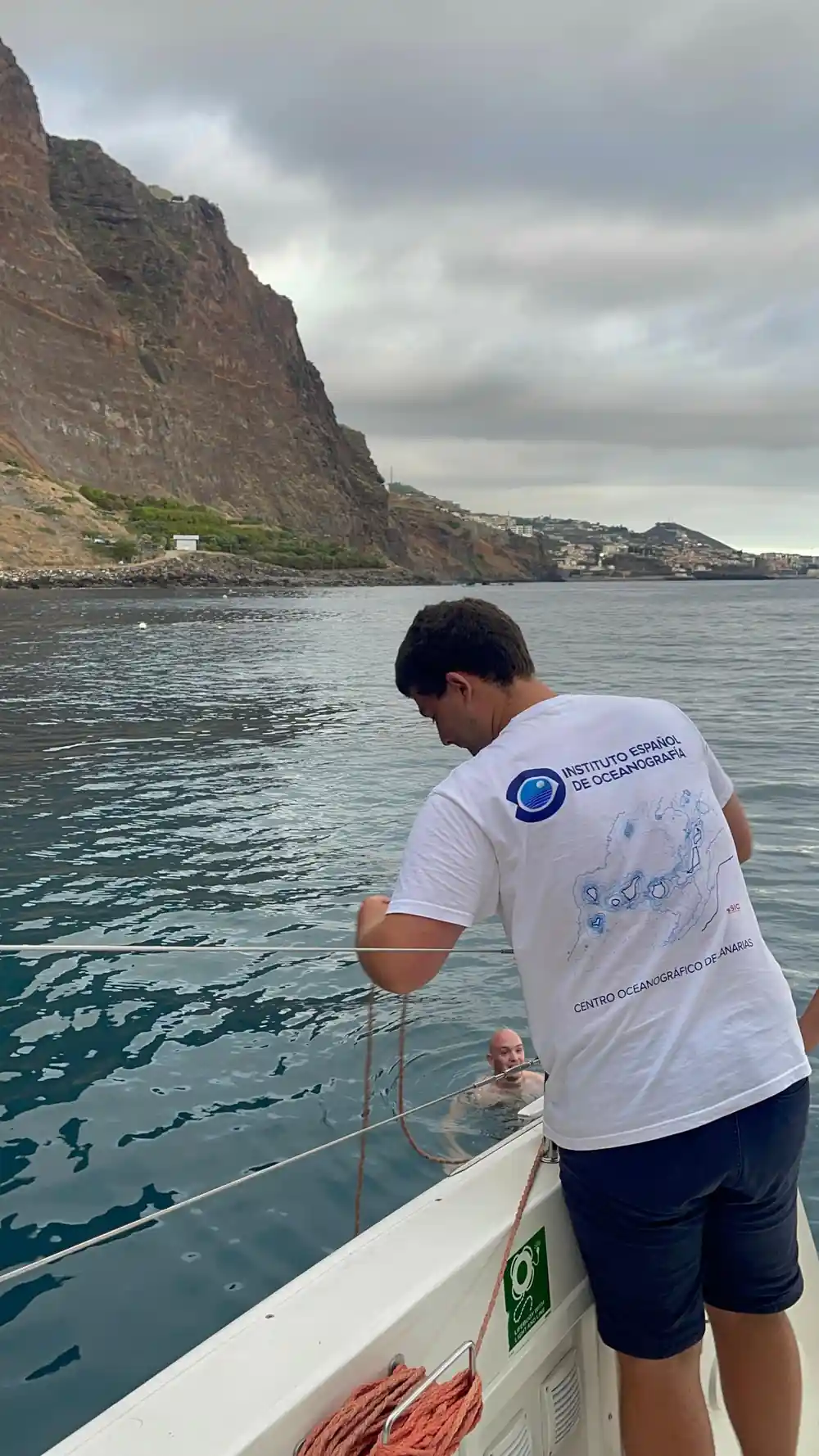
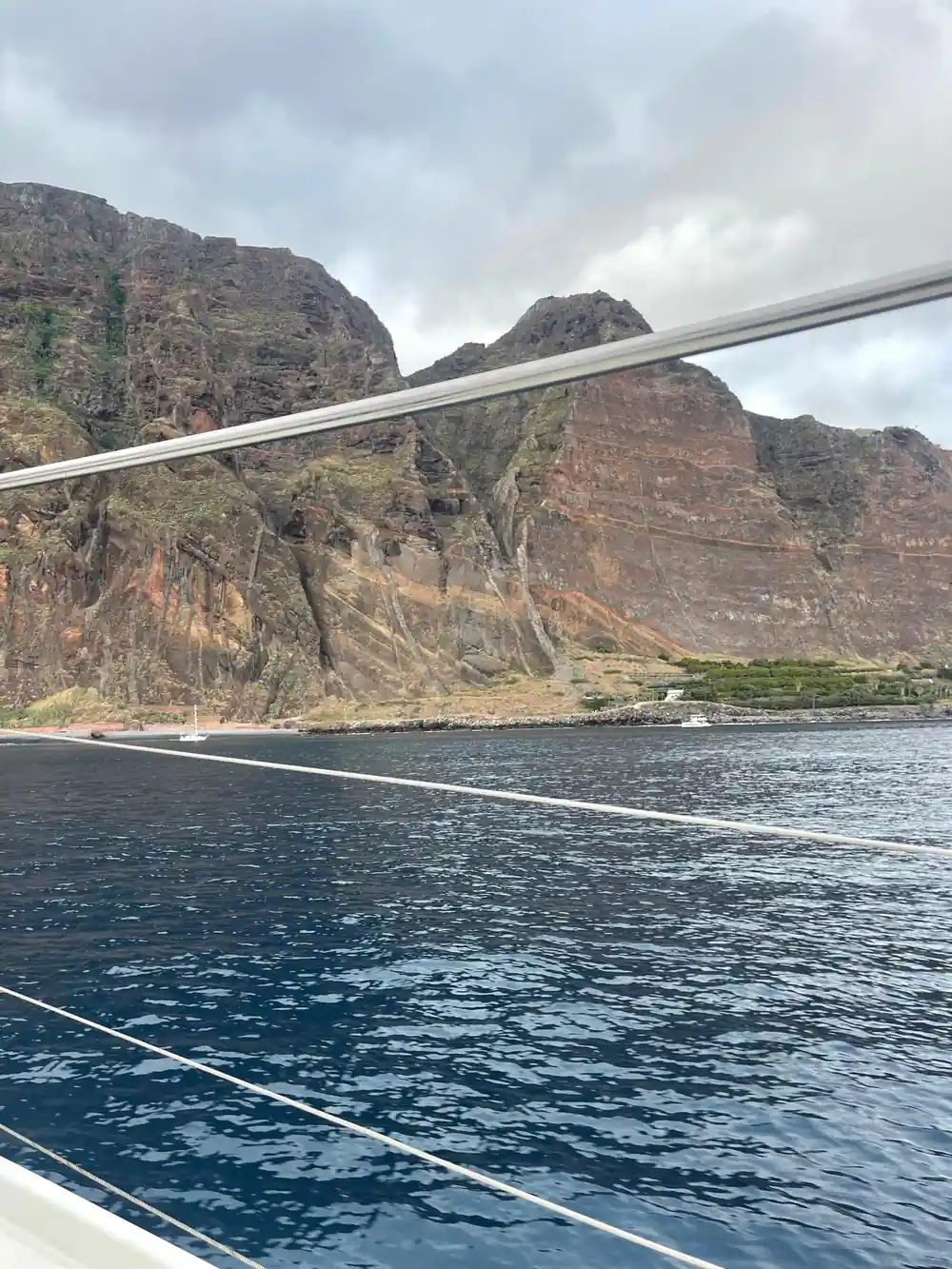
The shade also gives you a comfortable viewpoint for the scenery. Cabo Girão, a sea cliff rising 580 metres above the ocean, is passed on this cruise.[3][8] From the water, with the cliff face towering overhead, the scale of the island becomes clear. Vineyards cling to the slopes and a little skywalk juts out from the top. It is a good moment to put the binoculars down and just look.
The saloon and the practical bits
Down a few steps from the cockpit is the saloon, the catamaran's indoor room. It has big windows that sit close to the waterline, a table, bench seating and a trim of warm wood. It is the place to go if the spray picks up, or if you want a quieter spot with the world sliding past the glass. On a cooler day, the saloon holds warmth from the sun and gives you a view the deck cannot: the bow wave curling just below the window while the horizon rolls past.
The saloon is where you will find the practical touches: a toilet, space for bags and a surface for sunscreen, cameras and water bottles. There is usually room to change if you plan to swim, so pack light and keep your things in a dry bag. Non-slip shoes are a good idea on deck, and barefoot is fine on the nets but not on the gangway. You will also find the guide's notes and maps here, so it is worth stepping down once before the wildlife starts.
Guides are part of the practical setup too. On the Funchal Bay cruise the live guide speaks Portuguese and English, so you can ask about the species you see and the landmarks along the way.[3] They point out the low dark shapes between waves before your eyes catch them, and they explain which islands and capes are sliding past. A good guide also tells you when to look left, which matters on a boat where sightings can vanish in seconds.
from US$46
The Funchal Bay luxury catamaran cruise: 3 hours, a live guide, a secret stop and Cabo Girão on the route.[3]
Getting in and out of the water
The whole point of a catamaran swim stop is that the boat sits flat while you get in. There is a swim platform at the stern with a ladder, and because the hulls barely move, even hesitant swimmers manage it without drama. You step off the platform into clear water, and the climb back up is a simple case of taking the ladder one rung at a time. Families like this setup; there is no scramble over a bouncing rail.
The water off Funchal ranges from around 18°C in winter to 24°C in summer, so it is brisk but manageable.[4] Use the ladder to climb back up, keep your weight towards the boat, and listen to the crew's timing. They keep an eye on currents and call you in before the boat needs to move. If you are not a strong swimmer, stay close to the platform; the crew will pass you a buoy if you want one. The shorter the time between swim and towel, the better, so have your things ready.
What you swim in is calmer than the deep blue water offshore. Only five kilometres out, the seabed plunges beyond 3,000 metres, yet the coastline also offers protected bays and cliffs for the boat to pause at.[2] A towel, a change of clothes and a warm layer for after the swim complete the kit. Water dries fast in the Madeira air, but a breeze on wet skin can be chilly, so the warm layer is the bit people forget.
How many people are on board
Catamarans in Funchal range from intimate to very large, and capacity changes the feel of a trip. VMT Madeira's fleet includes the Sea Nature with 216 passengers, the Sea the Best with 98, and the Sea Pleasure with 70.[9] On a busy day, a big boat can still have room on deck, but a smaller one brings you closer to the guide and the rail. A good compromise for many people is a mid-size catamaran: enough space to move around, but not so many passengers that you queue for the view. If you want plenty of room to spread out with a drink, the larger boats are comfortable too.
The SeaBorn eco catamaran in Funchal has a maximum capacity of 100 guests.[10] That is typical of the mid-size luxury boats, which balance deck space with a less crowded wildlife experience. If being close to the action matters, a tour that caps numbers is worth choosing. Capacity also affects boarding and seating: on a smaller boat you can settle somewhere and stay there, while on a big one you might need to move around the deck to follow the action.
Whichever boat you pick, the crew manages positions during sightings, moving passengers from one side to the other so everyone gets a view. The Funchal Bay luxury catamaran cruise is rated 4.25 from 3,470 reviews on GetYourGuide, with Guide scoring 4.3, Transportation 4.5 and Value for money 4.2.[3] The practical point is to find a spot you like early, keep your belongings together, and trust the crew to point you the right way when something appears.
Sailing, or motoring
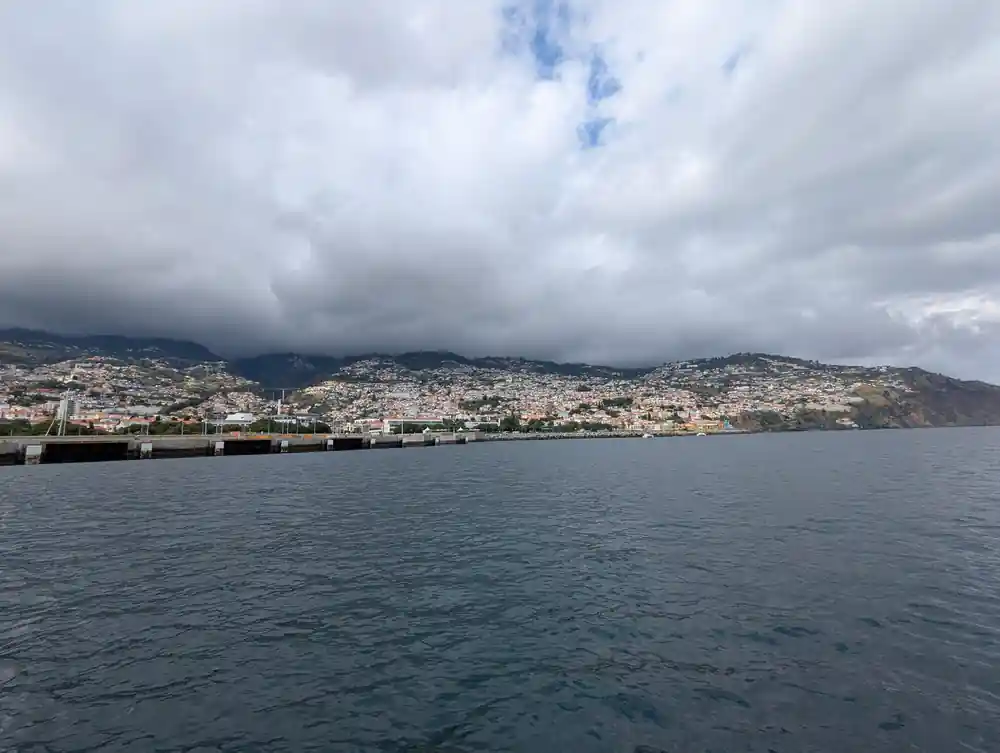
A catamaran leaves the marina under engine, threading past the pontoons before the sails go up. If the wind is right, the engines cut and the boat moves on the pressure of the sails alone. The sound changes completely: just water along the hulls and the creak of sheets. If the wind is light, you will motor for a while, and the crew watches for the moment the sails earn their place. Either way, the first part of the cruise is a slow, easy glide past the harbour front and the hills of Funchal.
Some boats in Funchal are built with an extra trick. The Magic Dolphin is an ecological catamaran; when sea life arrives, its electric engines engage for silent, emission-free cruising, which helps keep the cetaceans calm.[11] That silence makes a real difference when dolphins are riding the bow wave. The boat glides into the encounter without the rumble of a diesel engine, and the animals often stay closer for longer.
Finding the animals is partly local knowledge. One of the Madeira operators, Lobosonda, relies on a spotter ashore who passes mileage and landmarks to skippers, aiming boats toward the animals.[12] Out on the water, the crew also listens for blows and watches for splashes, then slows the engines so the animals decide how close they want to come. On a good day you will see the spotters' work pay off within the first hour.
Catamaran passenger capacity
Passenger capacities of catamarans operating in Funchal.[9][10]
Compare Funchal catamaran cruises
From-prices in USD on GetYourGuide.[3][5][6]
When to book
How to plan your cruise
Choose your boat
Compare the luxury catamaran from US$46 with other dolphin and whale watching tours in Funchal.[3]
Reserve, pay later
Book now and pay later; check availability for starting times.[3]
Pack for the sea
Take sun protection, a light layer and a swimsuit; the sea ranges from 18°C to 24°C.[4]
Board and find a spot
Skip the ticket line, meet the Portuguese and English speaking guide and settle on deck.[3]
Ready to meet Madeira's dolphins and whales from a luxury catamaran?
from US$47Reserve now & pay later